 How-to
Are Your Solar Pool Pump Signs of Failure Showing?
Last Updated: November 7, 2026
Quick Summary
The most common signs your solar pool pump is failing are unusual noises, weak flow from the return jets, loss of prime, air bubbles, overheating, unexpected shutdowns, and poor heating. Because most rooftop solar pool heating systems share the pump that runs your filter, these symptoms can also come from the solar side, so check both before assuming the pump is the problem.
- Most rooftop solar pool heating systems use the existing circulation pump instead of the existing pool circulation pump,.
- Weak return-jet flow often traces to a clogged impeller, basket, or filter.
- Compare filter pressure and return flow with the solar valve open and closed to tell pump trouble from collector trouble.
- A humming motor that won't start often points to a failing start capacitor or worn bearings.
- Repair makes sense for single-part failures; replacement is usually better for failing motors or cracked housings.
Table of Contents
- Why Your Solar Pool Heater Depends on the Pool Pump
- What Are the Signs Your Solar Pool Pump Is Failing?
- Why Is My Pool Pump Losing Prime?
- Why Is My Solar Pool Heater Not Working Even When the Pump Runs?
- How Variable-Speed Pumps Affect Rooftop Solar Heating
- How to Tell If Your Pool Pump Motor Is Bad
- Safe Troubleshooting Checklist for Homeowners
- Should You Repair or Replace Your Pool Pump?
- Get Professional Troubleshooting for Your Solar Pool Pump
- Frequently Asked Questions
Why Your Solar Pool Heater Depends on the Pool Pump
Most rooftop solar pool heating systems do not have their own pump. If you're weighing pump options for a solar loop, you can review pool heat pump installation, replacement and service options available from Florida Solar Pro.
This is why pump trouble often looks like a solar problem. A homeowner in Port St. Lucie, FL may think the panels have stopped working when the real issue is a worn pump or a suction leak.
Knowing the warning signs helps you act before a small pump problem becomes a costly repair.
What Are the Signs Your Solar Pool Pump Is Failing?
A failing pool pump usually gives warnings before it stops. Watch for these seven signs, and note that each one can also come from somewhere else in a solar heating system.
- Unusual noises such as grinding, screeching, rattling, or humming
- Weak flow from the return jets
- Loss of prime, where the pump runs but moves little or no water
- Air bubbles in the pump basket or pool returns
- Overheating of the motor or housing
- Unexpected shutdowns or a tripped breaker
- Poor heating, where the pool stays cool even on sunny days
Any one of these is worth checking. Two or more together usually means the pump needs attention. Here is how to read each sign and where else it can come from.
Unusual Noises and Weak Flow
Grinding or screeching often points to worn motor bearings. A humming motor that won't spin up can mean a failing start capacitor. Weak flow may come from a clogged impeller, a restricted pump basket, or a clogged filter.
On the solar side, weak flow at the returns can also mean a valve is partly closed, a check valve is stuck, or a collector loop is air-locked.
Air Bubbles, Overheating, and Shutdowns
Air bubbles usually mean a suction leak. If air is in the solar heating lines themselves, follow these steps to get air out of solar pool heating lines.
Air can also enter through the solar loop itself, a loose collector union, a failed vacuum breaker, or a drain-down valve that isn't seating. Bubbles that appear only when the solar valve opens point to the collector side, not the pump.
Poor Heating: Pump or Solar Side?
This is the sign that fools the most homeowners. A pool that stays cool on a sunny day can mean a weak pump, but it can just as easily mean:
- The controller isn't calling for heat because a roof sensor reads cool or has failed
- The diverter valve is stuck or set to bypass the collectors
- Clouds, shade, or a low sun angle are limiting gain, normal variation, not a failure
A quick way to separate the two: watch the pressure gauge and the return jets when the solar valve opens. If pressure rises and flow at the returns drops sharply, the restriction is likely in the collector loop. If flow was already weak before the valve opened, the pump is the more likely culprit.
Record a Baseline Before You Call
A useful diagnostic approach is comparing today's numbers to the system's normal numbers. Before anything fails, note:
- Filter pressure at a clean filter, in solar mode and bypass mode
- Return-jet strength at each setting
- Daily run time and the controller's displayed temperature readings
When a symptom appears, compare against that baseline. A pressure that runs several pounds higher than normal in solar mode points to a restriction in the collectors or valves.
Watch out: don't assume a cool pool means a dead pump.
Here is a quick reference for the seven warning signs, what each one usually means, and where else the symptom can come from.
| Sign | Likely cause | Check first |
|---|---|---|
| Unusual noises | Worn motor bearings or a failing capacitor | Listen at startup; note grinding or humming |
| Weak flow | Clogged impeller, basket, or filter | Clean baskets; compare return-jet strength |
| Loss of prime | Suction leak, low water, or faulty check valve | Inspect lid O-ring and water level |
| Air bubbles | Suction-side leak or solar loop air lock | Note whether bubbles appear only when the solar valve opens |
| Overheating | Running against restricted flow for too long | Check for restriction before restarting |
| Unexpected shutdowns | Tripped breaker or overheated motor | Check breaker and motor heat before restarting |
| Poor heating | Pump, controller, sensor, valve, or collector loop | Watch pressure and return flow when the solar valve opens |
Why Is My Pool Pump Losing Prime?
Losing prime means the pump can no longer draw a steady column of water. Common causes include:
- A clogged or dirty filter basket
- A leak in the suction line or pump lid
- A low water level that exposes the skimmer
Start with the simple fixes. Clean the baskets, confirm the water level, and inspect the lid O-ring. If the pump still won't hold prime, the problem may be in the plumbing or a valve.
Why Is My Solar Pool Heater Not Working Even When the Pump Runs?
A pump can run and still fail to move enough water through the collectors. Our guide on fixing leaks and restoring heat explains how to tell a leak or heat loss from a collector that needs replacing.
Other causes include:
- Valves set to the wrong position, sending water back to the pool without passing the collectors
- Air trapped in the collector loop
- Faulty sensors or controllers that never call for heat
If your system is a SunStar or Heliocol setup, the manufacturer's service documentation is the best reference for valve positions and controller settings. For authorized help, see SunStar solar pool heating service.
How Variable-Speed Pumps Affect Rooftop Solar Heating
Variable-speed pumps run at lower speeds for longer periods. This saves energy and can improve filtration. For solar heating, the flow rate matters.
If you have a variable-speed pump, check whether the solar heating mode is set to the correct speed. A pump set too low may keep the pool filtered but leave the solar heater underperforming. Consult your pump and controller documentation for the correct solar settings.
How to Tell If Your Pool Pump Motor Is Bad
A bad motor often shows several signs together:
- It hums but won't start
- It runs hot to the touch after normal operation
- It trips the breaker repeatedly
Before you assume the motor is bad, turn off power and check for loose wiring, a failing capacitor, and worn bearings. Work on electrical equipment should be done by a licensed professional.
Safe Troubleshooting Checklist for Homeowners
You can safely check several things yourself. For a deeper walkthrough, read how to diagnose underperforming solar pool panels before calling a professional.
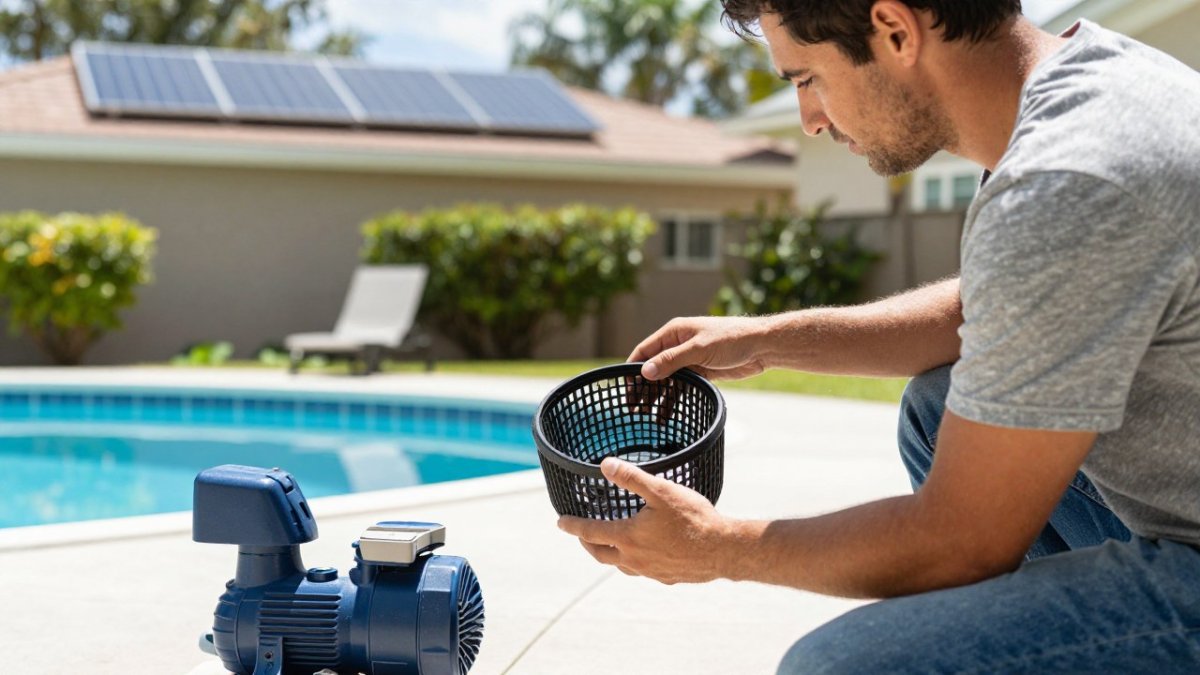
- Clean the pump basket and skimmer baskets
- Check that the water level is at the middle of the skimmer opening
- Inspect the pump lid O-ring for cracks or debris
Stop and call a professional if you see:
- Burning smells, sparks, or melted wiring
- Water near electrical connections
- A breaker that trips again after reset
Never climb onto the roof or open energized equipment to troubleshoot.
!A homeowner in a sunny Florida backyard inspecting the pool filter basket beside a pool pump, with the pool and rooftop solar panels visible behind them
Should You Repair or Replace Your Pool Pump?
Repair makes sense when the problem is a single part, such as a capacitor, O-ring, lid, basket, or seal. Replacement makes more sense when the motor is failing, the housing is cracked, or repairs would cost close to the price of a new pump. The trick is knowing which category your symptom falls into.
Symptoms That Usually Point to a Repair
- Humming but not starting: often a start capacitor, a relatively simple fix
- Air in the basket with good flow otherwise: usually a lid O-ring, union, or drain plug
- A visible leak at the pump seal: a seal or gasket replacement
Symptoms That Usually Point to Replacement
- Grinding or screeching that continues after a seal or bearing check: worn motor bearings on a motor near the end of its service life
- A motor that runs hot and shuts off repeatedly: often a winding problem
- A cracked housing or a leaking volute that won't seal: replacement is usually the practical call
- Repeated capacitor failures: a sign the motor itself is degrading
Weigh These Factors
- The age and condition of the pump
- Whether replacement parts are available for that model
- The remaining warranty, and whether a repair voids it
- The repair scope and cost compared with a new pump
There is no universal age cutoff. A well-maintained pump can outlast a neglected newer one, and a pump that's only a few years old can still be a poor repair candidate if the motor is failing. The honest answer depends on what the diagnostic finds.
How Variable-Speed Pumps Change the Math
If you're replacing, a variable-speed pump can be a good fit for a solar loop because you can set a higher speed for solar heating and a lower speed for filtration.
Florida Solar Pro can help you compare repair and replacement options for pool equipment and solar pool heating. If you're weighing a repair against a replacement, schedule a diagnostic and we'll tell you what the pump is actually doing before you spend on either.
Get Professional Troubleshooting for Your Solar Pool Pump
If your pool pump shows any of these warning signs, schedule a diagnostic with Florida Solar Pro. We will check the pump, the solar piping, and the controls to find the real cause.
Florida Solar Pro · Solar Energy Professionals · 1930 SW Biltmore St, Port St. Lucie, FL 34984 · 772-464-2663 · Licenses CVC56702 · CPC1458189 · CAC1817178 · SCC131153056
Frequently Asked Questions
What are the signs that a solar pool pump is failing?
Common signs include unusual grinding, screeching, or humming noises, weak or no return flow, the pump losing prime, air bubbles in the basket, motor overheating or shutting off, water leaks at the pump, and a tripped breaker. Because most rooftop solar pool heating systems run through the existing circulation pump, a failing pump often shows up first as poor heating. If you notice several of these symptoms together, have a professional inspect the pump and motor before running it further, since continued operation can cause additional damage.
How long does a pool pump usually last?
Lifespan depends on the pump type, how many hours it runs, water chemistry, and how well it is maintained. Many pump motors give years of service, but running a pump for long hours or with a restricted filter wears components faster. Variable-speed pumps often run longer at lower speeds, which can extend motor life. A pump that shows repeated noise, leaks, or overheating is likely near the end of its service life, regardless of age.
Why is my solar pool heater not working even though the pump is running?
A running pump does not guarantee water is reaching the solar collectors. Check for a clogged filter, a suction leak that draws air, a partly closed or faulty valve, or worn impeller components that reduce flow. Controls, sensors, or the solar valve can also keep the system from heating. Because these causes overlap, start with the simple checks in our troubleshooting checklist, and call a professional if flow and heating do not improve.
Should I repair or replace a failing pool pump?
The right choice depends on the cause and cost of the repair, the pump's age, the availability of parts, and the condition of the motor. A worn seal, basket, or capacitor is often a simple repair. A seized motor, cracked housing, or repeated failures usually points to replacement. Florida Solar Pro can inspect the pump and explain the repair scope before you decide, and pricing depends on the specific equipment and work required.