 Comparison
Pool Heat Pump Worth the Cost? A Florida Owner's Guide
Last Updated: November 20, 2026
Quick Summary
A pool heat pump is worth the cost for Port St. Lucie homeowners who swim through the cooler months and will use the pool regularly, provided the unit is sized correctly. It makes less sense for a pool that sits unused from November to March, so your swimming habits decide the answer.
- A heat pump moves heat from outdoor air into the water instead of burning fuel, so it can deliver more heat than the electricity it uses.
- Estimate daily cost as power draw in kilowatts times run hours times your electric rate, using your own bill.
- A pool cover is the largest single lever most homeowners control to cut heat loss and run hours.
- Undersizing is the most common mistake; treat a sizing calculator result as a starting point, not a final answer.
- Pairing a heat pump with solar pool heating often covers more of the year than either alone.
Table of Contents
- Is a Pool Heat Pump Worth the Cost in Port St. Lucie?
- How a Pool Heat Pump Works and What Drives Efficiency
- What a Pool Heat Pump Operating Cost Looks Like Locally
- Using a Pool Heat Pump Sizing Calculator Before You Buy
- Pool Heat Pump vs. Solar Pool Heating: Which Fits Your Pool?
- Pool Heat Pump vs. a Gas Pool Heater
- Pros, Cons, and the Payback Question
- Schedule a Pool Heating Assessment in Port St. Lucie
- Frequently Asked Questions
Is a Pool Heat Pump Worth the Cost in Port St. Lucie?
For most Port St. Lucie homeowners who swim through the cooler months, a pool heat pump is worth the cost when the pool gets regular use and the equipment is sized correctly.
A heat pump makes sense for a family that wants a longer swimming season without gas heater fuel bills. It makes less sense for a pool that sits unused from November to March.
Below, we break down how these units work, what drives operating cost here, and how they compare with solar pool heating and gas.
How a Pool Heat Pump Works and What Drives Efficiency
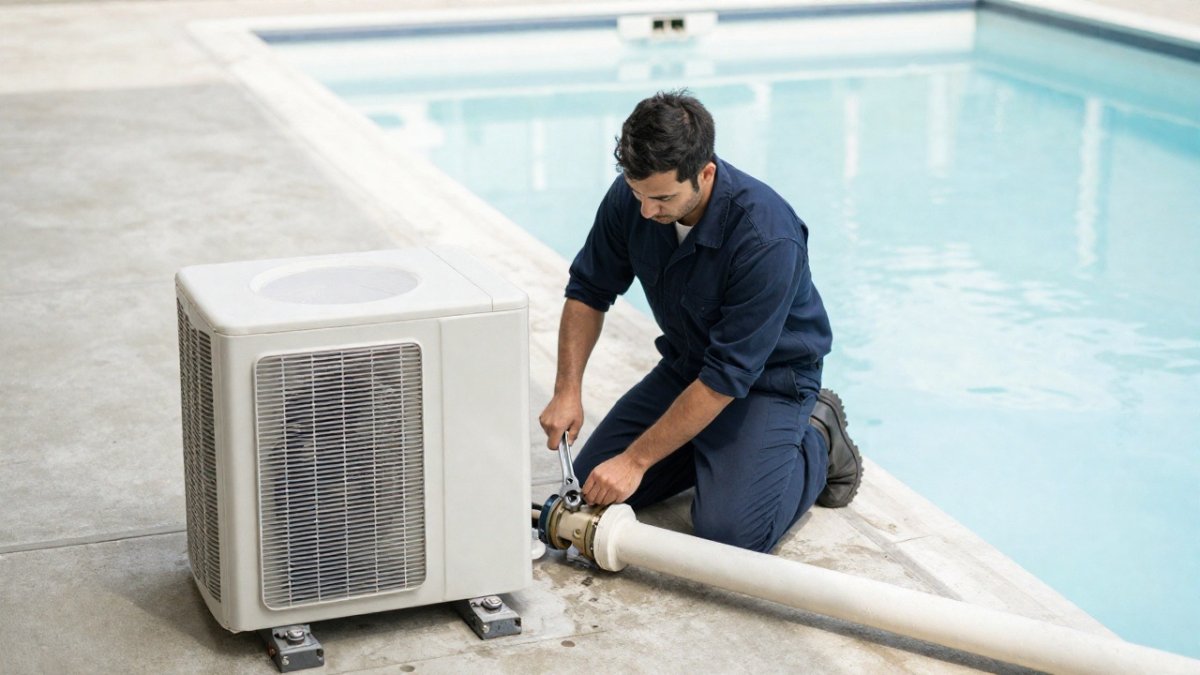
A pool heat pump is an electric device that moves heat from the outdoor air into your pool water instead of generating heat by burning fuel.
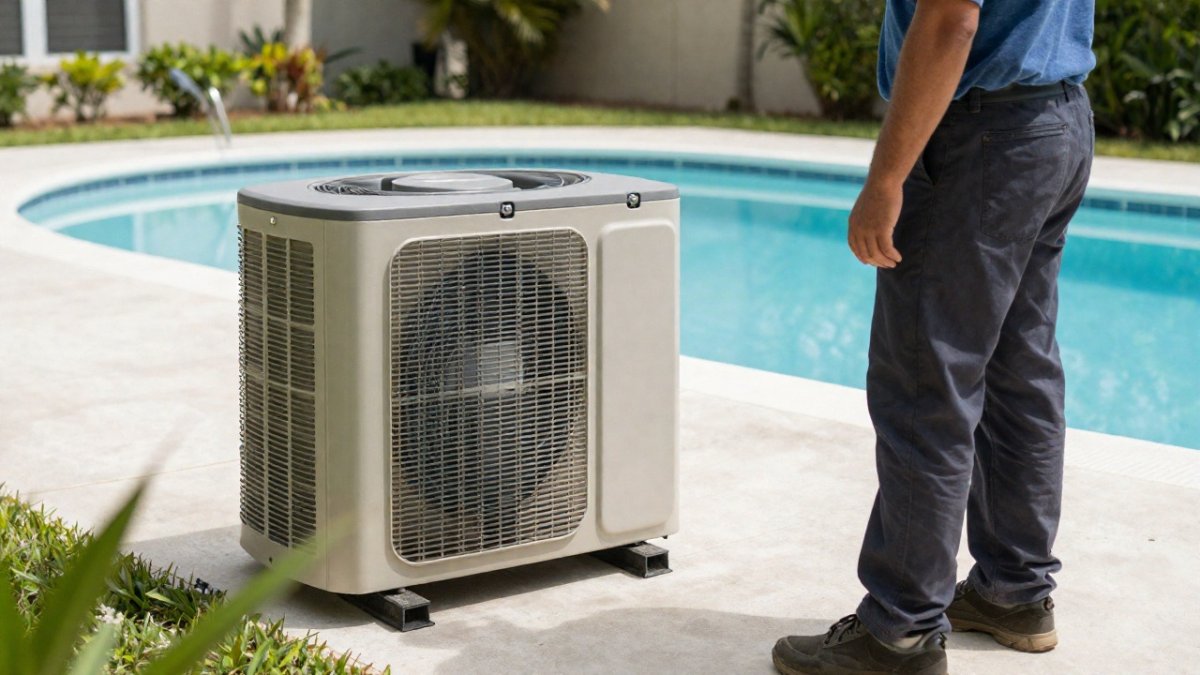
Because it moves heat rather than creates it, a heat pump can deliver more heat energy than the electricity it consumes. That ratio is why the technology appeals to Florida homeowners.
Coefficient of Performance and Ambient Air Temperature
Coefficient of Performance (COP) is the ratio of heat delivered to electricity consumed. A higher COP means more heat per kilowatt-hour, but COP falls as outdoor air cools because there is less heat to pull from the air. In a warm, humid Port St. Lucie summer, a heat pump runs near its best efficiency; on a chilly January morning, it works harder and heats more slowly. That is why run time and outdoor temperature matter as much as the unit's rating.
What a Pool Heat Pump Operating Cost Looks Like Locally
Operating cost is where most pool heat pump decisions are won or lost. A heat pump's monthly bill in Port St.
The formula is simple: power draw in kilowatts × run hours × your electric rate = daily cost. Run hours swing widely by month.
Your rate depends on your provider. Your utility determines your rate, and it is not the same for every customer across our service area. Check the rate on your own bill, including any tiered or time-of-use structure, before you estimate.
A Worked Example You Can Adapt
The formula is power draw times run hours times your rate. Plug in the figures from your own unit's specifications and your utility bill to estimate your costs.
Watch out: run hours are the number homeowners guess worst. A unit that seems cheap on paper can run 12 hours a day if the pool is uncovered, windy, and set high. That is why we measure the equipment pad and ask about cover use before recommending a size.
Humidity, Wind, and Pool Cover Effects on Heat Loss
Port St. Lucie's warm, humid air is good for heat pump efficiency, but the same climate drives heavy evaporation, and evaporation is the biggest heat thief a pool has. Minimizing these losses through physical barriers significantly improves the overall heat pump cost and efficiency for year-round operation.
Wind exposure matters too. A pool on an open, breezy lot loses more heat than one sheltered by a screen enclosure or landscaping. If your pool feels cold and you want to understand why, our guide on why your pool water is cold walks through the common causes.
What Changes the Estimate Most
- Set temperature: every degree you raise the target adds run time, and the relationship is not linear in cool weather.
- Cover use: the largest single lever most homeowners control.
- Pool size and surface area: a larger surface loses more heat, regardless of volume.
- Month and ambient temperature: COP falls as air cools, so January costs more per unit of heat than June.
- Electric rate structure: flat, tiered, or time-of-use all change the answer.
If you want to see how a heater integrates with pumps, timers, and controls that let you schedule run hours around your rate, our pool automation installation and upgrades service covers that. Build an estimate from your pool, your rate, and your habits, not a national average.
Using a Pool Heat Pump Sizing Calculator Before You Buy
A pool heat pump sizing calculator matches heater capacity to your pool's water volume and your climate. Undersizing is the most common mistake we see: a unit that can't keep up runs constantly and still disappoints. Sizing uses pool volume, desired temperature rise, and heat loss factors.
Most calculators ask for gallons and surface area, then recommend a heat output in BTUs. Treat the result as a starting point, not a final answer. Shade, wind exposure, and cover use change the real requirement.
Pool Heat Pump vs. Solar Pool Heating: Which Fits Your Pool?
Solar pool heating and a heat pump solve the same problem in different ways. Solar collectors use sunshine to warm water, but output drops on cloudy days and in cool snaps. A heat pump runs on electricity and works day or night, though its efficiency falls in cold air.
| Factor | Pool Heat Pump | Solar Pool Heating |
|---|---|---|
| Fuel source | Electricity | Sunlight |
| Works at night | Yes | No |
| Cloudy-day output | Steady | Reduced |
| Upfront cost | Moderate to higher | Often lower |
| Operating cost | Electricity dependent | Very low |
| Best for | Cool-weather swimming | Warm-season, sun-exposed pools |
Many homeowners combine the two. As an authorized Heliocol and SunStar dealer, we install and service solar pool heating that can pair with a heat pump for shoulder-season coverage.
Pool Heat Pump vs. a Gas Pool Heater
A gas pool heater, whether natural gas or propane, heats fast and holds temperature well in cold weather. That speed comes at a higher operating cost per unit of heat, and it depends on a fuel supply.
Choose gas if you need rapid heat for occasional use. Choose a heat pump if you want steady heating across a long season and have the electrical capacity on your equipment pad. We assess compatibility with your existing setup before recommending either.
Pros, Cons, and the Payback Question
Here is the honest ledger, and then the part most articles skip: how to think about payback without pretending we can promise you one.
On the plus side, a heat pump extends your swimming season, runs efficiently in warm air, avoids fuel deliveries and storage, and holds temperature steadily. On the minus side, it heats gradually, loses efficiency as ambient air cools, adds electrical load to your equipment pad, and needs the right electrical capacity to run safely.
- Pro: Longer swimming season and steady temperature maintenance.
- Pro: Moves heat instead of burning fuel, so there is no combustion or fuel supply to manage.
- Pro: No propane tank, no fuel deliveries, no combustion venting.
- Con: Slower heating speed than gas, it is a maintainer, not a rapid heater.
- Con: Efficiency drops as ambient air temperature falls, so cool snaps cost more per unit of heat.
- Con: Requires adequate electrical service and a sensible equipment-pad location.
How to Think About Payback Without a Promise
Payback is not a fixed number, and any article that hands you one is guessing. Compare three scenarios on the same assumptions: no heater, a heat pump, and gas.
Homeowners who swim most of the year generally reach a payback crossover sooner than those who heat only for occasional weekends. If you heat a few weekends a season, the operating savings may never catch the upfront cost, and a different approach, including solar pool heating, may fit better.
Decision Guidance by How You Actually Swim
The right answer depends less on the equipment than on your habits.
- Year-round or near-year-round swimming: a heat pump is usually the strongest fit, especially paired with a cover and, where it makes sense, solar pool heating for shoulder-season help.
- Occasional weekend heating: a heat pump can work, but the upfront cost is harder to justify against limited use; weigh it against gas if you need fast heat, or against solar if your swim season is mostly sun-driven.
- Spa or rapid temperature increases: a heat pump heats gradually, so if you need fast recovery for a spa, that is a real trade-off to discuss before buying.
- Shoulder-season only: combining a heat pump with solar pool heating often covers more of the year than either alone, because solar carries the sunny days and the heat pump carries the cool, cloudy ones.
- Pool that sits unused in winter: the case for a heat pump weakens; spend the money elsewhere or revisit when your habits change.
As an authorized Heliocol and SunStar dealer, we install and service solar pool heating that pairs well with a heat pump, and we install and service Gulfstream units on the heat pump side. If you want to compare options directly, our pool heat pump installation and service page covers what we offer, and we are glad to walk your equipment pad and give you a straight recommendation.
Schedule a Pool Heating Assessment in Port St. Lucie
The right answer depends on your pool, your roof, your utility, and how you actually swim. A short assessment sorts that out.
Call Florida Solar Pro at 772-464-2663 to schedule a pool heating assessment in Port St. You can also request solar and pool heating service through our Port St.
A cold pool in the cooler months usually comes down to heat loss, not a broken system.
Florida Solar Pro · Solar Energy Professionals · 1930 SW Biltmore St, Port St. Lucie, FL 34984 · 772-464-2663 · Licenses CVC56702 · CPC1458189 · CAC1817178 · SCC131153056
Frequently Asked Questions
Are pool heat pumps worth it in Port St. Lucie, Florida?
For many Port St. Lucie homeowners, yes, if you want to extend the swimming season into cooler months and your pool is not already served by solar heating. The area's warm ambient air temperature and long swimming season suit heat pump operation. Whether a pool heat pump is worth the cost depends on your pool size, how often you swim, and local electricity rates. A sizing check and an operating-cost estimate before purchase will tell you more than a generic payback figure.
What is the major disadvantage of a pool heat pump?
The main drawback is that performance drops as outdoor temperature falls, because a heat pump moves heat from the ambient air rather than generating it. In cool weather, heating speed slows and run time lengthens. Upfront cost is also higher than a basic gas heater in some cases, and the unit needs electricity to run. Proper sizing and a pool cover reduce these effects, but a heat pump is not the fastest option for quick temperature rise.
Can a pool heat pump work with a solar pool heating system?
Yes, the two can be combined, though compatibility depends on your existing equipment, valves, and controls. Solar pool heating performs well in sunny weather, and a heat pump can supplement it during cloudy or cooler stretches. A pool heat pump vs. solar pool heating decision does not have to be either-or. We assess the system actually present before recommending integration, and we do not guarantee universal compatibility.
How do I know what size pool heat pump I need?
Start with pool volume and surface area, then factor in desired temperature rise, typical outdoor temperature, and whether you use a pool cover. A pool heat pump sizing calculator gives a starting estimate in BTUs, but the final size should account for your specific pool and site. Oversizing wastes money; undersizing means long run times. We can review your pool details and recommend a model, such as a Gulfstream unit, that fits your setup.