 how-to
Solar Pool Heating Repair in Okeechobee, FL
Table of Contents
- Solar Pool Heating Repair in Okeechobee, FL: What to Expect
- How Solar Pool Heating Works on an Okeechobee Roof
- Solar Pool Heating Not Working? Five Things to Check First
- Pool Solar Panel Leak: Finding It Before It Wrecks the Roof
- Solar Pool Controls, Valves, and Sensors: The Parts That Fail Quietly
- Storm Damage, Roof Straps, and Freeze Nights in Okeechobee
- Repair or Solar Pool Heating Replacement? Do the Warranty Math
- When the Original Installer Is Out of Business
- What Happens During a Diagnostic Visit
- Why Call Florida Solar Pro
- Sources
- Frequently Asked Questions
Last Updated: October 8, 2026
Solar Pool Heating Repair in Okeechobee, FL: What to Expect
If your pool is cold and the panels on the roof look fine, you need solar pool heating repair in Okeechobee, FL, and you need someone who will actually show up. At Florida Solar Pro, we're a licensed Florida solar and pool contractor (CVC56702 and CPC1458189) serving Okeechobee, Sebring, and Fort Pierce. This guide covers what breaks and when to fix versus replace.
Solar pool heating is a closed loop of black plastic collectors on your roof that circulates pool water through the sun's heat and returns it warmer. No compressor. No gas. Just flow, sun, and a controller deciding when to run the pump.
That simplicity is why repairs are usually straightforward. It's also why homeowners get talked into full replacements they didn't need.
We've worked on Florida pools for 30 years, and we're an authorized Heliocol and SunStar dealer and manufacturer warranty service provider.
Below, we'll walk through the five things to check before you call anyone, how to find a leak before it rots your roof deck, and the warranty math that helps decide whether to repair or replace.
How Solar Pool Heating Works on an Okeechobee Roof
Water leaves your pool pump, passes through a filter, then hits a diverter valve that sends it up to the roof instead of straight back to the pool. The panels absorb heat from the sun. The water returns warm.
Three parts do all the work:
- The collectors. Hundreds of small tubes welded into a mat. Water moves through them slowly so the sun has time to heat it.
- The headers. The larger pipes at each end of the panel. Supply on one side, return on the other.
- The controls. A valve actuator, a controller, and two sensors. One sensor reads roof temperature. One reads pool water temperature.
Okeechobee sits inland, which matters. Inland freeze nights in January and February are colder than what coastal Stuart or Fort Pierce see. That's hard on headers and on any water left sitting in the panels.
Florida Solar Energy Center solar pool heating overview
The Loop, the Panels, and the Controls
The controller compares roof temperature to pool temperature. If the roof is warmer, it tells the actuator to turn the diverter valve and send water up. If the roof is cooler than the pool, it closes the valve and the water bypasses the panels entirely.
When that logic fails, you get one of two problems. Either the valve never opens, so no water ever reaches the roof. Or it never closes, so you cool your pool at night through panels radiating heat away.
Most "solar pool heating not working" calls we run in Okeechobee come down to that valve, that actuator, or a sensor reading wrong.
Solar Pool Heating Not Working? Five Things to Check First
Before you spend money on a service call, run these five checks. Each one takes a few minutes. Each one tells you something specific.
- Look at the controller display. What you'll see: a blank screen, an error code, or a temperature reading. What it means: a blank screen usually points to power or a blown fuse. A reading that says the roof is 70 degrees at noon in July means a bad roof sensor.
- Watch the actuator on the diverter valve. What you'll see: the handle should rotate when the controller calls for heat. What it means: if it never moves, the actuator or the controller signal has failed.
- Check the filter pressure gauge. What you'll see: a reading well above your clean-filter baseline. What it means: restricted flow. Low flow through the panels means poor heating even when everything else works.
- Feel the return line at the pool. What you'll see: water coming back noticeably warmer than the pool. What it means: if the return is cold while the pump runs and the sun is out, water isn't reaching the roof.
- Look for air bubbles at the pool returns. What you'll see: sputtering, bubbles, or a pump that won't prime. What it means: a suction-side air leak or a leak in the roof loop pulling air in.
Symptom, Cause, and Whether You Can Fix It Yourself
| Symptom | Likely Cause | DIY or Pro |
|---|---|---|
| Pump runs, pool stays cold | Diverter valve stuck or actuator dead | DIY check, pro repair |
| Controller screen blank | Power, fuse, or transformer | Pro |
| Bubbles at pool returns | Suction air leak or roof loop leak | Pro |
| Water on roof deck near panels | Header or tube leak | Pro |
| System short-cycles on and off | Sensor reading wrong | Pro |
| Weak flow at returns | Clogged filter or failing pump | DIY filter, pro pump |
Pool Solar Panel Leak: Finding It Before It Wrecks the Roof
A pool solar panel leak is the one problem you should never sit on. Water and roof decking don't mix, and by the time you see a ceiling stain inside, the damage is done.
Most leaks start at the headers, not the middle of the panel. The header takes the most stress from heat cycling, and on older systems the plastic gets brittle from years of UV. A hairline crack at a header fitting can drip for months before anyone notices.
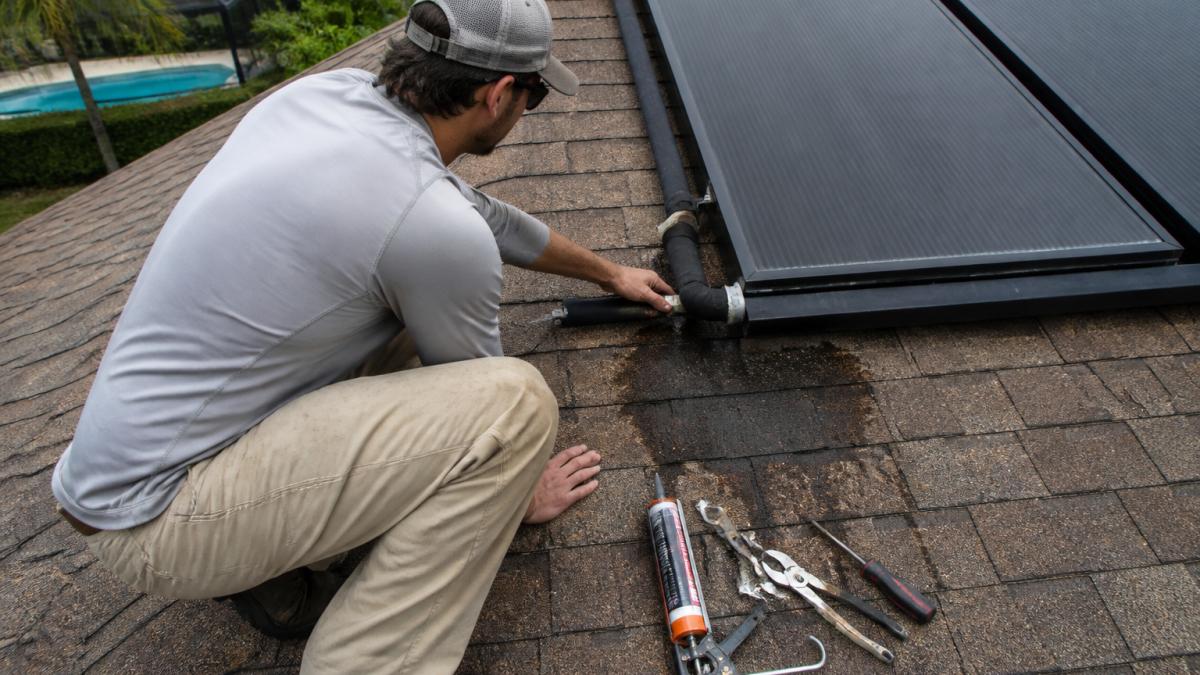
Here's how we find them. We pressure-test the loop and watch the gauge. A slow drop means a leak somewhere in the panels or plumbing. Then we isolate sections. Panels are usually valved in banks, so we can shut off one bank at a time and see if the pressure holds.
What most homeowners miss is that the leak isn't always where the water shows up. Water runs along rafters and roof strapping before it drops. The stain inside is often 10 feet from the actual crack.
If you've got a wet spot on the roof deck under the panels, stop running the system. Call us at 772-464-2663 and we'll get eyes on it.
Solar Pool Controls, Valves, and Sensors: The Parts That Fail Quietly
Solar pool controls fail more often than panels do. The panels are passive plastic. The controls have moving parts, electronics, and sensors sitting in Florida heat and rain year-round.
The parts we replace most:
- Actuators. The motor that turns the diverter valve. When it dies, the valve stops moving and the system stops heating.
- Diverter valves. The valve body itself cracks or the internal seal wears out. You get water bypassing the panels or leaking at the valve.
- Controllers. Boards corrode, displays fail, and programming gets wiped after a power surge from an afternoon thunderstorm.
- Sensors. The roof sensor and the pool sensor. A roof sensor reading 20 degrees low will keep the system off on a perfectly good heating day.
Magen Eco-Energy solar pool heating product information
A common mistake we see is replacing the whole controller when only the roof sensor failed. The sensor is a small part. Test it before you condemn the board.
Storm Damage, Roof Straps, and Freeze Nights in Okeechobee
Hurricane season runs June through November, and Okeechobee takes inland wind and hail that coastal homeowners sometimes escape. After a storm, the first thing to check is the roof straps and panel mounting.
Panels that shift even an inch can chafe against the roof surface. That chafing wears through the panel and the shingle underneath. We've pulled panels off roofs in Okeechobee and found the shingles worn down to the mat where a strap loosened two seasons earlier.
Inland freeze nights are the other Okeechobee-specific risk. On a clear January night, temperatures in Okeechobee and Sebring can drop below freezing while Stuart and Fort Pierce stay warmer. Water left in the collectors expands when it freezes. That's how headers crack.
Freeze protection comes down to two things: a controller with a freeze-guard setting, and a system that actually drains or circulates when the temperature drops. If your controller doesn't have that setting, or it's not turned on, you're gambling every cold snap.
Okeechobee County Building Department
Repair or Solar Pool Heating Replacement? Do the Warranty Math
Repair is usually the right call. Replacement makes sense when the panels are past their warranty and failing in multiple places at once.
Here's the math we walk homeowners through:
- Age of the panels. Heliocol carries a 12-year warranty when installed by an authorized dealer and 8 years when it isn't. If you're inside that window and the failure is a defect, warranty may cover the panel.
- Number of failures. One leak is a repair. Three leaks in three different banks in one season means the plastic is done.
- Condition of the roof. If your shingles are near the end of their life, replacing panels now and pulling them again for a re-roof is throwing money away.
- Repair history. A system that's needed a repair every year for three years is telling you something.
Warranty assistance is subject to eligibility, and we don't assume another contractor's workmanship warranty. If your original installer cut corners, the manufacturer's warranty on the parts may still apply even when the labor warranty doesn't. We sort that out during the diagnostic.
When the Original Installer Is Out of Business
More than a dozen Florida solar installers have closed and left their customers with no one to call. If that's you, you're not stuck.
We take over orphaned systems. That means we identify what you have, check whether the manufacturer warranty is still valid, and repair it. You don't need the original installer to get warranty parts on a Heliocol or SunStar system. You need an authorized service provider.
That's where the dealer status matters. We're an authorized Heliocol and SunStar dealer and manufacturer warranty service provider, so we can file warranty claims on systems we didn't install.
What we can't do is honor someone else's workmanship warranty. If the original installer's labor was the problem, that's on them, and they're gone. But the parts warranty is a separate thing, and it often survives.
What Happens During a Diagnostic Visit
We run a solar pool heating diagnostic the same way every time, because skipping steps is how you miss the real problem.
- Visual inspection of the roof. Panels, straps, penetrations, and the roof surface under them.
- Controller and sensor check. We read live temperatures and compare them to actual conditions.
- Valve and actuator test. We command the valve open and closed and watch it move.
- Flow and pressure test. Filter pressure, pump performance, and flow at the returns.
- Leak test. Pressure-test the loop and isolate banks if it won't hold.
- Written findings. What's wrong, what it takes to fix it, and whether warranty applies.
Our Solar Rescue Assessment is a flat $149 with a 2-hour diagnostic cap. If you enroll in a Service Protection Plan within 30 days, the full $149 credits toward the plan.
Why Call Florida Solar Pro
We're a family company. The owner answers the phone, the people who quote your job are the people who service it, and nobody in another state decides to close the local branch.
We're a licensed multi-trade contractor: CVC56702 for solar, CPC1458189 for pool and spa, CAC1817178 for HVAC, and SCC131153056 for structural. We're an authorized Heliocol and SunStar dealer and manufacturer warranty service provider from Brevard County through Miami-Dade. We also carry GulfStream pool heat pumps, which make sense as a supplement when you want warm water through a cold snap that solar alone can't cover.
Service Protection Plans start with Pool Solar Guard at $239 a year. Every plan includes priority response, a repair discount, one complimentary service call, and warranty management.
Call 772-464-2663 and we'll get your pool back to swimming temperature.
Sources
- Florida Solar Energy Center, University of Central Florida
- Magen Eco-Energy
- Okeechobee County Building Department
- U.S. Department of Energy, solar pool heating
A cold pool in Okeechobee usually comes down to one failed part, not a system that's reached the end of its life. The trick is finding which part without paying for a replacement you didn't need.
Florida Solar Pro is a licensed solar and pool contractor serving Okeechobee, Sebring, and Fort Pierce. We handle Heliocol and SunStar repair, warranty service, panel replacement, and GulfStream heat pump installs, backed by 30 years in Florida solar and licenses CVC56702 and CPC1458189. Call 772-464-2663.
Florida Solar Pro ·, Solar Energy Professionals, · 1930 SW Biltmore St, Port St. Lucie, FL 34984 · 772-464-2663 · Licenses CVC56702 · CPC1458189 · CAC1817178 · SCC131153056
Frequently Asked Questions
Why is my pool cold when the sun is out?
Most of the time the collectors are fine and the water simply is not reaching them. Check the controller first: it should show the roof sensor warmer than the pool and the pump running during the heating window. If the actuator has not rotated the diverter valve, water bypasses the roof entirely. Air in the lines, a clogged filter, or a failed sensor will do the same thing. A solar pool heating repair visit starts with flow and controls, not panels.
How can I tell if my solar pool heater has a leak?
Look at the pool level, the roof, and the ground. A pool solar panel leak usually shows as a dark wet patch on the roof decking, water staining on the fascia or soffit, or a puddle under the equipment pad. On the pool side, you may lose an inch or more a day with no other explanation. Shut the system down and call for repair before the leak reaches the attic or ceiling drywall.
Can a solar pool heater be repaired, or do I need a whole new system?
Most systems are repairable. Couplings, headers, diverter valves, actuators, sensors, and controllers are all replaceable parts. A single cracked panel can often be swapped without touching the rest of the array. Full solar pool heating replacement usually makes sense only when the collectors are past their service life, the roof is being replaced, or storm damage spans multiple rows. Age, warranty status, and the cost of the repair decide it.
Can I get Heliocol or SunStar warranty service if my original installer is out of business?
Often yes. Florida Solar Pro is an authorized Heliocol and SunStar dealer and manufacturer warranty service provider. Warranty assistance is subject to eligibility, and we do not assume another contractor's workmanship warranty. We can inspect the system, document the failure, and work through the manufacturer on covered parts. Call 772-464-2663 with your system age and any paperwork you still have.