 how-to
How to Get Solar Repair After Your Installer Closes
Last Updated: November 5, 2026
Quick Summary
You can get solar repair after your installer closes by hiring a licensed solar contractor who services existing systems, since the equipment still belongs to you. Manufacturer warranties usually survive the closure, but the installer's workmanship warranty often ends with the business. Start with a diagnostic visit and whatever system records you have.
- Your panels keep producing power after a closure, but no local crew remains to honor workmanship promises.
- A licensed contractor can diagnose and repair a system another company installed, and Florida requires proper state licensing.
- Manufacturer coverage is issued by the equipment maker and usually survives, subject to its terms and eligibility.
- Recovering monitoring access often starts by contacting the platform directly and proving system ownership.
- Repair usually wins when the fault is isolated and parts are available, with no universal age cutoff.
Table of Contents
- What Happens to Your System When a Solar Company Closes
- Can Another Licensed Contractor Handle Orphaned Solar System Repair?
- Your Solar Panel Warranty if the Installer Goes Out of Business
- Finding Your Solar System Information and Warranty Documents
- Common Failures: Solar Inverter Repair, Wiring, and Falling Output
- What a Professional Solar System Inspection Covers
- Repair or Replace? Weighing an Orphaned System
- Schedule a Diagnostic Visit for Your Orphaned System
- Frequently Asked Questions
What Happens to Your System When a Solar Company Closes
When a solar installer closes, your panels keep making power but nobody is left to honor the workmanship side of the deal. The equipment still belongs to you.
That situation is what the industry calls an orphaned system. Solar repair after your original installer goes out of business starts with one fact: the system is not doomed. Florida Solar Pro offers a plain overview of what happens next and how to start the rescue process.
Here at Florida Solar Pro, we help homeowners with these situations across Port St. Lucie and South Florida.
Three things typically happen when a solar company closed:
- The phones go dead. Warranty requests and service tickets vanish.
- Monitoring accounts get stranded. Your production data may sit on a portal nobody manages.
- Workmanship promises may end. Manufacturer coverage applies to parts under its own terms, while the installer's labor obligations depend on that company.
The equipment is still yours. The next step is finding someone licensed to service it.
Can Another Licensed Contractor Handle Orphaned Solar System Repair?
Yes. A licensed solar contractor can diagnose, repair, and maintain a system another company installed.
In Florida, solar electric work requires proper state licensing.
What most homeowners miss is that servicing a brand does not make a contractor an authorized dealer for it.
For orphaned systems in Palm Beach County and Broward County, the practical path looks like this:
- Confirm the contractor's license and insurance.
- Share whatever system records you have.
- Book a diagnostic visit before authorizing repairs.
Find the solar repair and diagnostics service you can book when you're ready to move from paperwork to a real inspection.
Your Solar Panel Warranty if the Installer Goes Out of Business
Your solar panel warranty if the installer goes out of business usually depends on who wrote it.
The manufacturer warranty covers the equipment itself, such as panels, inverters, and sometimes racking.
The workmanship warranty covers the installation labor. It was issued by the installer, so its availability depends on that company and its written terms.
Here is the split in plain terms:
| Warranty Type | Who Issues It | If the Installer Closes |
|---|---|---|
| Equipment manufacturer | Panel, inverter, or racking maker | Usually survives, subject to its terms |
| Workmanship | The original installer | Often ends with the business |
| Monitoring or service plan | The installer or a third party | Check who holds the account |
Watch out: manufacturer warranty terms vary, and labor to remove and reinstall a failed part may not be covered.
Finding Your Solar System Information and Warranty Documents
Locating your system documentation makes every later step faster. Start with what you already have, then work outward. If the original installer held the master monitoring credentials, recovering them is often the hardest part, so we cover that first.
Recovering access to your monitoring portal
Many orphaned systems still report to a portal the installer controlled. Common platforms include Enphase Enlighten, SolarEdge Monitoring, SMA Sunny Portal, Fronius Solar.web, and APsystems EMA. If you can see production data but can't log in as the owner, you may be stuck on a sub-account the installer created.
A practical path looks like this:
- Identify the platform from the app icon, the inverter label, or the login screen.
- Contact the platform's support directly and ask about transferring system ownership to your account.
- Be ready to prove ownership: a utility bill at the service address, a closing document, or a signed contract.
- Have equipment serial numbers handy, they are usually on the inverter label and inside the portal.
Watch out: some platforms require the current site administrator to release the system before ownership can move. If the installer's account is dormant, support may need to intervene, and that can take time.
Pulling permit and inspection records
Your city or county building department keeps the permit history for the installation. In Florida, that record may include the contractor of record, the equipment listed on the permit, and the final inspection result. Request it in writing from the building department that has jurisdiction over your address. This is useful when paperwork is missing and you need to confirm what was actually installed and inspected.
Reading the labels on your equipment
Panel backs, inverter housings, and racking components carry make, model, and serial number labels. A technician records these during an inspection. Do not climb onto the roof to read them yourself, the labels can be captured safely during a service visit.
What to gather before you call
- Your closing folder or email from the original sale
- Any monitoring app login you still have
- Permit records from your city or county
- Your homeowner insurance file, including any storm claim
For systems in South Florida, storm history matters too. Note any hurricane damage and whether an insurance claim was filed. That record helps explain fault patterns later. If a manufacturer warranty may apply, we help with eligible claim procedures once the equipment is documented.
See how our solar repair and diagnostics service handles documentation during a visit.
Common Failures: Solar Inverter Repair, Wiring, and Falling Output
Solar inverter repair is a common service for orphaned systems. The inverter is the box that converts panel DC power into usable AC power for your home (Solar Integration: Inverters and Grid Services Basics).
Other frequent problems include:
- Microinverter or optimizer faults that knock out single panels
- Monitoring errors where the portal shows no data or wrong numbers
- Loose or damaged wiring after storm movement or pest intrusion
- Ground faults and arc faults that trip the system offline
- Reduced output from shading, soiling, or failing equipment
What can you safely check? Look at the monitoring app, note the error code, and confirm the system is switched on.
Brand compatibility depends on the model and system, so we confirm what applies to your equipment during the visit. See how inverter and monitoring diagnostics work before you authorize a replacement.
What a Professional Solar System Inspection Covers
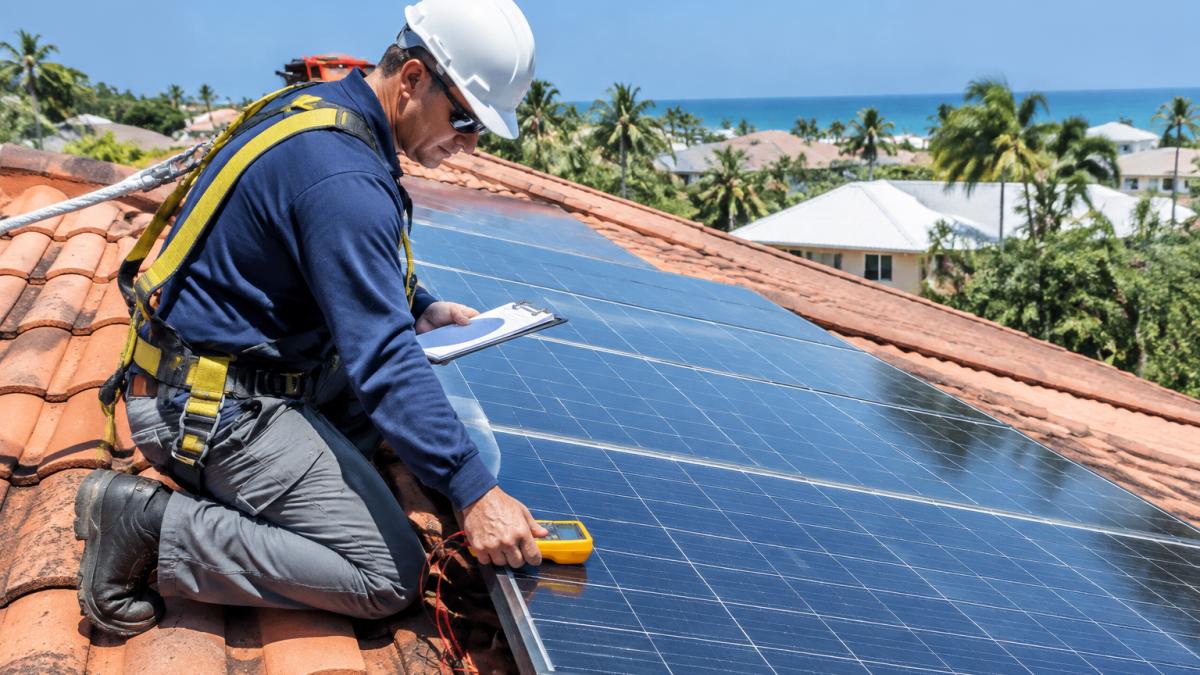
A solar system inspection is a documented review of your array, wiring, inverter, and safety equipment to find faults and confirm what still works. It answers the question homeowners care about most: is this fixable?
Vetting the contractor before you book
This step matters as much as the inspection itself. Before you authorize anyone to work on an orphaned system in Port St. Lucie, Palm Beach County, or Broward County, confirm these points:
- State license. Ask for the license number and verify it with the state. Solar electric work in Florida requires proper licensing for the scope, and electrical permits are pulled when the job calls for one.
- Insurance. Ask for proof of general liability and workers' compensation coverage. A crew on your roof without workers' comp is a risk to you.
- Scope fit. Confirm the contractor services existing systems rather than only installing new ones.
- Written findings. Ask whether you receive photos and a written summary, not just a verbal opinion.
- Warranty language. A contractor should separate manufacturer coverage, the original installer's workmanship obligations, and their own warranty on their work. Be wary of anyone who promises to take over another company's workmanship warranty.
Servicing a brand does not make a contractor an authorized dealer for it, so treat certification claims as separate from repair capability.
What the inspection includes
A typical inspection covers:
- Roof and mounting review, including roof integrity and penetration seals
- Wiring, conduit, and rapid shutdown checks
- Inverter and monitoring diagnostics
- Production testing against expected output
- Photos and a written summary of findings
Reading the findings
The report should tell you what failed, what is at risk, and what is healthy. A single failed inverter is a repair conversation.
We also document the system for your records. That matters for insurance claims and for any future reroof. If your roof needs work, plan the panel removal and reinstallation with a licensed crew rather than a roofer alone.
Request a professional solar inspection and get the findings in writing.
Repair or Replace? Weighing an Orphaned System
Repair usually wins when the fault is isolated and parts are available. Replacement makes more sense when multiple major components are failing or the equipment is no longer supported.
Weigh these factors:
- Condition: one failed inverter is a repair. A array full of cracked panels is a bigger conversation.
- Compatibility: can the failed part be matched to your existing equipment?
- Parts availability: some older models are hard to source.
- Remaining warranty: active manufacturer coverage changes the math.
- Repair scope: a single component versus system-wide rewiring.
There is no universal age cutoff. A well-built system can serve for decades with maintenance, while a poorly installed one may fail early. Judge the equipment, not the calendar.
Schedule a Diagnostic Visit for Your Orphaned System
A closed installer leaves you with questions, not answers.
At Florida Solar Pro, our own crew handles the work, and we're fully insured, including workers' compensation. We identify the fault, document your equipment, and explain your repair options in plain terms.
Schedule a diagnostic visit for your orphaned system or call 772-464-2663. Homeowners in Broward and South Florida can reach our South Florida line at 954-372-3358.
Frequently Asked Questions
What happens to my solar warranty if the installer goes out of business?
Two warranties usually cover a home solar system, and they survive differently. Equipment coverage from the manufacturer is tied to the hardware, not the installer, so panel and inverter warranties typically remain valid if the product was registered and the claim meets the manufacturer's terms. The workmanship warranty is a contract with the installer, so it usually disappears with the company. Keep your documents and ask a licensed contractor to help you file an eligible manufacturer warranty claim.
Can another licensed contractor repair my system even though they didn't install it?
Yes. A licensed Florida solar contractor can diagnose and repair an orphaned system without being the original installer. We service existing systems across Port St. Lucie, Palm Beach County, Broward County, and the rest of South Florida, and we help homeowners pursue eligible manufacturer warranty procedures. Servicing a brand does not make us the manufacturer's authorized dealer for every product, so we confirm what applies to your specific equipment before any work begins.
My panels still make power but the monitoring app shows errors. What should I do?
Monitoring errors often point to a communication problem, a tripped breaker, or a failing inverter rather than dead panels. Check that the system is switched on, note the exact error code, and look at your last power bill to see whether production actually dropped. Do not open the inverter or climb on the roof. A solar system inspection with proper test equipment will tell you whether you need solar inverter repair or a simpler fix.
Should I repair or replace a system when the original installer is gone?
It depends on the age and condition of the equipment, whether replacement parts are still available, remaining manufacturer warranty, and the scope of the fault. A single failed inverter or a damaged section of wiring is often worth repairing. A system with multiple failing components and no parts support may cost more to keep alive than to replace. A diagnostic visit gives you the facts to compare both paths before you spend.
Your system was built to last longer than the company that installed it. Let us diagnose what's wrong and get your production back where it belongs. Get started with Florida Solar Pro and book a diagnostic visit today.
Florida Solar Pro · Solar Energy Professionals · 1930 SW Biltmore St, Port St. Lucie, FL 34984 · 772-464-2663 · Licenses CVC56702 · CPC1458189 · CAC1817178 · SCC131153056