 how-to
How to File Solar Insurance Claims After a Storm
Table of Contents
- What to Do in the First 24 Hours After a Storm Hits Your Solar System
- How to Do a Solar Panel Storm Damage Assessment Before You Call Anyone
- Insurance Claim Documentation for Solar Systems: What Your Adjuster Needs
- Step-by-Step: How to File Your Solar Insurance Claim
- Solar System Repair After a Hurricane: What Gets Fixed vs. Replaced
- When to Stop and Call a Licensed Solar Contractor
- Why Port St. Lucie Homeowners Call Florida Solar Pro
- Frequently Asked Questions
Last Updated: October 4, 2026
What to Do in the First 24 Hours After a Storm Hits Your Solar System
Filing solar insurance claims after a storm starts with three moves: photograph everything, don't touch damaged equipment, and call your insurer before you call anyone else. Florida Solar Pro handles these claims across Port St. Lucie and the Treasure Coast every hurricane season.
Here's what matters most in those first hours.
- Photograph the array from the ground. Wide shots first, then close-ups.
- Don't climb the roof. Wet panels are slick, and cracked glass cuts.
- Call your insurance company. Open the claim before you get repair quotes.
- Write down the date and time the storm passed through your area.
- Leave the breaker alone if you see scorch marks or smell burning.
One thing homeowners get wrong: they call a solar company first. Your insurer wants to hear from you before any work begins, even temporary work.
How to Do a Solar Panel Storm Damage Assessment Before You Call Anyone
A solar panel storm damage assessment is a ground-level inspection you can do safely in about 15 minutes. You're looking for four things: broken glass, shifted panels, exposed wiring, and roof damage around the mounts.
Walk your property line first. Then work closer.
What you'll see vs. what it means:
| What You See | What It Usually Means | DIY or Pro |
|---|---|---|
| Cracked or shattered glass | Impact damage, panel is done | Pro |
| Panels tilted or misaligned | Clamps or rails shifted | Pro |
| Loose wires hanging | Conduit or connector failure | Pro, stay back |
| Missing shingles near mounts | Penetration leak risk | Pro |
| Debris on the array | Usually harmless, don't climb | DIY removal from ground |
| Water stains on ceiling | Roof leak at a penetration | Pro, urgent |
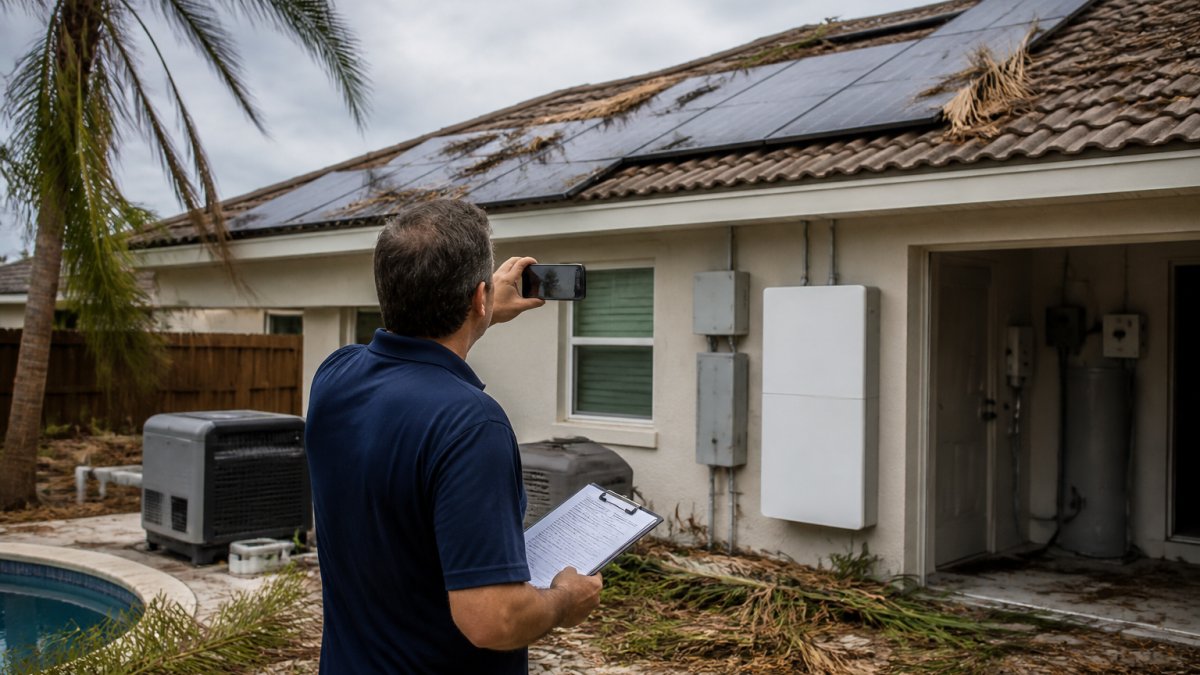
That last row is the one people miss. A ceiling stain two rooms away from the array is often a failed roof penetration, not a plumbing leak.
What You'll See vs. What It Means
Two panels can look identical and be in totally different shape.
Hail pocks the glass without cracking it. You'll see small white dimples. Those panels still work, but the manufacturer may void the warranty on impact damage. Microcracks are invisible from the ground and show up later as output loss.
Shifted panels are the bigger worry. If a panel moved, the rail system moved too. That means the roof attachment points took a load they weren't designed for.
Insurance Claim Documentation for Solar Systems: What Your Adjuster Needs
Insurance claim documentation for solar systems comes down to three things: proof of ownership, proof of damage, and proof of value. Adjusters deny claims that are missing any one of them.
Start a folder. Digital is fine.
Photos, Serial Numbers, and Monitoring Data
Photos. Shoot wide, medium, and close for every damaged area. Include something for scale, like a tape measure or a shoe. Date stamps help.
Serial numbers. Every panel has one on the back. Your installer's paperwork or your monitoring portal usually lists them. If you can't reach the back of a panel, the invoice plus the monitoring app is often enough.
Monitoring data. This is the strongest evidence you have and most homeowners forget it. Export your production history. A graph showing normal output on Monday and zero on Tuesday proves the storm caused the loss. Screenshot it before the data rolls off.
- Copy of your homeowner's policy
- Original install invoice and contract
- Panel and inverter spec sheets
- Monitoring export, before and after
- Photos with dates
- Any contractor report you already have
For guidance on what insurers expect in a property damage claim, the Florida Department of Financial Services consumer resources walks through the process step by step. The National Association of Insurance Commissioners homeowner claims guide is also worth reading before you talk to your adjuster.
Step-by-Step: How to File Your Solar Insurance Claim
Here's the order we'd follow. Skipping a step usually costs you money.
Step 1: Report the claim. Call your insurer's claims line. Get a claim number and the adjuster's name. Write both down.
Step 2: Document everything. Photos, serial numbers, monitoring data. Do this before debris gets hauled away. What you'll see: nothing changes yet. What it means: you've locked in your evidence.
Step 3: Get a professional inspection. A licensed solar contractor can tell you what's damaged and what's just dirty. This report carries weight with adjusters. What you'll see: a written scope of damage. What it means: you have a number to compare against the adjuster's estimate.
Step 4: Meet the adjuster on site. Be there. Point out the ceiling stain, the shifted panel, the scorched connector. Adjusters are busy and miss things. What you'll see: their initial estimate. What it means: this is a starting point, not a final answer.
Step 5: Review the settlement. Compare it line by line against your contractor's report. If they don't match, say so in writing.
Step 6: Schedule the repair. Don't cash the check and sit on it. Delayed repairs lead to more damage, and insurers notice.
Solar System Repair After a Hurricane: What Gets Fixed vs. Replaced
Solar system repair after a hurricane usually means replacing panels and fixing everything around them. Panels themselves are rarely repairable. Mounts, rails, conduit, and wiring often are.
Here's the split:
Usually replaced:
- Cracked or shattered panels
- Inverters that took a surge
- Corroded connectors
Usually repaired:
- Racking and rails
- Roof penetrations and flashing
- Conduit runs
- Disconnects and rapid shutdown devices
The Age and Warranty Math
This is where the decision gets made. Run the numbers before you agree to anything.
If your panels are under 10 years old and still under a manufacturer's power warranty, replacement panels should come from the manufacturer, not your insurer's depreciated payout. Push for that.
If your system is 15 years or older, the insurer may only pay depreciated value. In that case, replacing the whole array can make more sense than chasing parts.
Check your inverter warranty separately. Most carry 10 to 12 years. A surge-damaged inverter inside that window is a warranty claim, not an insurance claim. Don't let your insurer pay for something the manufacturer covers. Distinguishing between manufacturer obligations and policy coverage remains a critical step in navigating the broader insurance claim guide.
When to Stop and Call a Licensed Solar Contractor
Stop and call when you see any of these:
- Scorched or melted connectors
- A burning smell near the inverter
- Water inside the inverter housing
- Panels hanging off the rail
- Any exposed conductor at ground level
- A ceiling stain under the array
Those are not DIY items. A DC arc fault can start a fire inside a wall. A panel hanging by one clamp can come down on someone.
Also call if your system is simply dead and you can't tell why. Storm damage often hides in the rapid shutdown system or a ground fault that trips after the storm passes. That takes a meter and a trained eye.
We see this constantly in Port St. Lucie, Fort Pierce, and Stuart: a system that "looks fine" but produces nothing. Nine times out of ten it's a ground fault or a tripped rapid shutdown device, not the panels.
Why Port St. Lucie Homeowners Call Florida Solar Pro
We're a family company. The owner answers the phone. The people who quote your job are the people who service it, and nobody in another state decides to close the local branch.
We've been doing Florida solar for 30 years. We're licensed across four trades: CVC56702 for solar, CPC1458189 for pool and spa, CAC1817178 for HVAC, and SCC131153056 for structural. We're certified on Enphase, SolarEdge, SMA, Fronius, APsystems, Tesla, and Generac.
We also take over systems other companies walked away from. If your original installer closed and left you with a warranty nobody honors, we handle warranty management and get the claim filed right.
Our Solar Rescue Assessment is $149 flat, capped at two hours, and it's credited back in full toward a Service Protection Plan if you enroll within 30 days. Free estimates on new systems and replacements. We work from south of Daytona to Miami and west to Sebring.
If you're in Port St. Lucie, Okeechobee, or Sebring and a storm just rolled through, call us before you sign anything from an adjuster.
Storm claims move fast, and the paperwork decides the outcome. If your array is damaged and you're not sure what's fixable, get a licensed set of eyes on it before you accept a settlement. Florida Solar Pro offers a $149 flat Solar Rescue Assessment with a two-hour diagnostic cap, and it's credited in full toward a Service Protection Plan if you enroll within 30 days. We handle warranty management, storm damage repair, and full system replacement across Port St. Lucie, Fort Pierce, Stuart, and the rest of our service area. Call 772-464-2663 and let's get your system back online.
Florida Solar Pro ·, Solar Energy Professionals, · 1930 SW Biltmore St, Port St. Lucie, FL 34984 · 772-464-2663 · Licenses CVC56702 · CPC1458189 · CAC1817178 · SCC131153056
Frequently Asked Questions
Does homeowners insurance cover solar panel storm damage?
In most Florida policies, rooftop solar panels are covered as part of the dwelling structure. Wind, hail, and flying debris damage typically falls under your hurricane or windstorm deductible, which is often higher than your standard deductible. Flood damage is separate and requires a flood policy. Check your declarations page for the wind deductible amount before you file, so you know what you're responsible for out of pocket.
What documentation do I need for a solar insurance claim?
You'll need dated photos of the damage from multiple angles, your solar system's serial numbers and model info, inverter or monitoring app data showing output drop, your original installation paperwork, and a written assessment from a licensed solar contractor. If your system was installed by a company that has since closed, gather whatever paperwork you have. A contractor who handles orphaned systems can help reconstruct the missing details.
Should I call a solar professional before filing an insurance claim?
Yes. An adjuster sees the roof, but may not know how to test an inverter, check rapid shutdown, or read monitoring data. A licensed solar contractor can document what's actually broken versus what looks fine, and that report strengthens your claim. We do a two-hour diagnostic for a flat $149, and that fee is credited toward a Service Protection Plan if you enroll within 30 days.
Does my solar warranty cover storm damage?
Manufacturer warranties cover defects, not storm damage. Panel and inverter warranties typically exclude acts of nature. That's what insurance is for. If your original installer has closed and you're in Port St. Lucie, Fort Pierce, or Stuart, we take over warranty management on orphaned systems and can tell you what's still covered versus what goes to your insurance claim.